
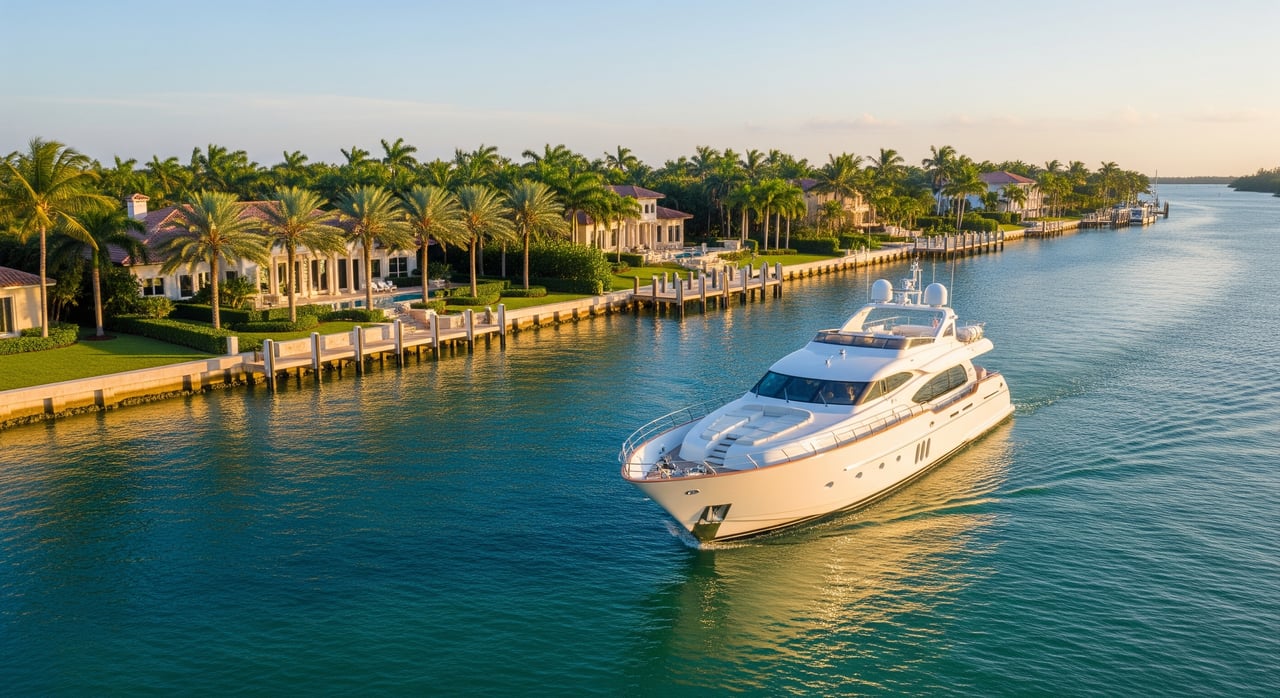
If you own or plan to own a yacht in Port Royal, your first question is simple: how quickly and safely can you reach the Gulf without bridge delays. You want clarity on Gordon Pass, canal depths, and where a large vessel can turn without stress. In this guide, you will learn the essentials of Port Royal’s bridge-free route, the dynamics of Gordon Pass, and the canal and dock factors that matter before you buy. Let’s dive in.
Why Port Royal works for yacht owners
Port Royal sits on the southwest side of Naples Bay, close to Gordon Pass and the open Gulf. The route from a private dock to the Gulf is bridge-free, so you avoid fixed vertical clearance limits. For many yachts and recreational boats, the run to open water is measured in minutes. Typical trips are often under 20 minutes, depending on your dock location and speed.
This proximity is a standout feature. It means more time on the Gulf and less time navigating long inland channels. For day boating, fishing, and quick sunset runs, the convenience is hard to match.
Gordon Pass essentials
Gordon Pass is the natural tidal inlet that connects Naples Bay to the Gulf of Mexico. It is maintained through periodic dredging, but conditions change with seasons and storms. Tidal flow can be strong, and sandbars can shift over time. Staying current on conditions is part of safe, stress-free boating.
Timing and conditions
Currents build and fade with the tide cycle. Ebb tides that push out to sea can create turbulence across shallow bars. Many skippers time transits for favorable tides or near slack water when draft is tight. If you are new to the pass, plan a first run in settled weather and moderate seas.
Before you go, check the latest nautical charts, tide and current predictions for Naples, and the U.S. Coast Guard Local Notice to Mariners for buoy changes or shoaling advisories. Collier County and City of Naples shoreline updates can also signal dredging or sand movement that affects the inlet.
Hazards to respect
Shoaling and shifting sandbars near the entrance can reduce usable depth. Breaking waves may form when shallow water meets an ebbing current and swell. Wind can also set you off your preferred track in a confined approach.
Traffic adds to the equation. Expect recreational boats, fishing craft, and transient traffic, especially on weekends and holidays. Keep speeds controlled, maintain situational awareness, and allow extra room for large vessels to maneuver in the channel.
Pre-run checks that pay off
- Review NOAA charts or ENCs that cover Naples Bay and Gordon Pass.
- Check NOAA tide and current predictions for Naples to plan draft-sensitive transits.
- Scan the U.S. Coast Guard Local Notice to Mariners for temporary changes and dredging.
- If you are unfamiliar, consider a practice run with a local professional captain or tow service.
- Keep your depth sounder calibrated and do not rely only on published soundings in dynamic areas.
Port Royal canals and turning basins
Port Royal’s waterfront is a network of private canals and dredged basins that serve single-family estates. These canals vary by width and depth. Many were created to host sizable private vessels, yet every lot is different. What works for a 60-foot sportfish may not work for a 110-foot motoryacht without careful planning.
Draft, beam, and swing room
Usable depth depends on maintenance history and seasonal changes. Obtain current depth soundings at mean low water along the entire approach to any prospective dock. Beam matters too. Measure clearance between seawalls and consider how other boats tie off in the canal.
Turning basins are usually positioned where canals meet wider water or at cul-de-sacs. The ability to turn depends on your LOA and beam, the available basin diameter, and your propulsion. Twin engines, thrusters, and azipods increase maneuverability, but space still rules. For very large yachts, owners sometimes use tugs or professional assistance to pivot safely.
Dock infrastructure and responsibilities
Bulkheads, seawalls, and the dredged area seaward of the bulkhead are often the responsibility of the lot owner. That means ongoing costs for dredging and seawall work can sit with you. Permits for dredging or structural changes may involve Collier County, the City of Naples, state agencies such as the Florida Department of Environmental Protection, and the U.S. Army Corps of Engineers.
If a property is within an association, review any rules that govern vessel type, size, tenders, or commercial activity from private docks. Confirm slip agreements or transient options if you plan to host visiting boats.
Due diligence for yacht buyers
A disciplined checklist protects your purchase and your boating experience.
Verify dock and canal specs
- Obtain recent depth soundings from the dock face to open water at mean low water.
- Measure beam clearance between seawalls and confirm distances to the nearest turning basin.
- Confirm there are no vertical clearance issues. Port Royal’s route is bridge-free, but verify local structures or temporary obstructions.
Understand maintenance and permitting
- Ask who is responsible for dredging and seawall upkeep and request maintenance records.
- Review any HOA or local restrictions on vessel size, tender use, and operations.
- Note permitting authorities for future work, including county, city, state, and federal agencies.
Plan real-world operations
- Arrange a local familiarization run through Naples Bay and Gordon Pass to learn approach lines and safe speeds.
- Discuss insurance requirements for coverage areas, salvage provisions, and any local knowledge clauses.
Use authoritative sources before each transit
- NOAA charts and tide/current tables for Naples and Gordon Pass.
- U.S. Coast Guard Local Notice to Mariners and published corrections.
- Collier County and City of Naples updates on dredging and shoreline projects.
Operations and services nearby
Port Royal owners often operate from private docks, then use nearby marinas for fuel, pump-outs, and service. You will find transient slips, fueling, waste services, and repair options along Naples Bay and the downtown waterfront. For larger haul-out or refit work, many owners select regional yards within Southwest Florida that can handle megayacht capacities. Always verify availability and lift limits in advance.
Provisioning is straightforward with land-side options close to the docks. For fueling, establish a primary plan and a backup at municipal or commercial marinas. Private dock fueling may require special arrangements and strict environmental compliance. Build redundancy into your plan so a temporary closure does not disrupt a trip.
Anchorage options exist in parts of Naples Bay and nearby protected areas. Conditions and regulations vary. Many owners prefer overnighting at private docks or in designated anchorage zones. Be sure to understand local rules and seagrass protections before you set the hook. Tender storage and launching may also be subject to local codes and HOA provisions.
Emergency and professional support is close at hand. Local towing and salvage providers, professional captains, and marine trades operate throughout Naples. The U.S. Coast Guard and local marine law enforcement provide search and rescue and enforce regulations. Keep essential numbers and radio channels at the helm.
A sample day: dock to Gulf
Picture a calm morning. You review tide predictions for Naples and plan to clear Gordon Pass near slack water. Lines are off, and you ease down the canal, minding wake and watching your depth sounder. As you enter Naples Bay, you merge with light traffic and follow the marked channel.
Approaching the pass, you stay within the favored track and confirm set and drift from the tide. Outside, the Gulf is settled. Within minutes, you are past the bars and on open water. On the return, you arrive near slack again, then swing in your basin with plenty of room and secure at the dock. The routine is simple because your planning was precise.
Common scenarios and smart solutions
Your yacht draws more than your neighbors’ boats
- Schedule transits near favorable tides and confirm recent soundings in the approach. Practice slow-speed handling with wind and current present.
The turning basin by your lot looks tight
- Compare your vessel’s turning radius to the basin diameter. Use thrusters or professional assistance for first maneuvers. Consider dock line strategies that reduce pivots in tight quarters.
Seasonal shoaling after a storm
- Check the Local Notice to Mariners and recent county or city announcements. Expect buoy relocations or temporary depth reductions until dredging is complete.
Holiday weekend traffic
- Leave early, keep speeds modest, and communicate intentions clearly. Maintain extra spacing in the pass and resist last-minute course changes.
Work with a discreet, data-forward advisor
Selecting the right Port Royal property for serious boating means aligning lifestyle, vessel specs, and long-term stewardship. You deserve a quiet process that protects your privacy and delivers confidence. The Knox Brothers pair concierge-level advisory with proprietary market intelligence to help you evaluate coastal estates with a boater’s lens. From evidence-based pricing and timing to thoughtful listing strategies, you receive a clear path to the right outcome.
Ready to discuss a Port Royal property that fits your yachting life. Schedule a private conversation with the Knox Brothers.
FAQs
Are there any bridges between Port Royal and the Gulf via Gordon Pass?
- No. The route from Port Royal through Naples Bay to the Gulf via Gordon Pass is bridge-free, so you avoid fixed vertical clearance limits.
How long does it take to reach the Gulf from a Port Royal dock?
- Most transits are measured in minutes and are often under 20 minutes, depending on your exact dock location and cruising speed.
Can large motor yachts transit Gordon Pass year-round?
- Many large yachts use Gordon Pass, but feasibility depends on your draft and beam and the current dredge and channel conditions. Verify recent depths and consider tide timing before transiting.
How do turning basins affect which Port Royal property I should buy?
- Turning room varies by canal and lot. Compare your vessel’s turning radius and beam to the available basin and canal width, and obtain measurements or a practical trial maneuver before you commit.
Who maintains canal depths and seawalls for Port Royal properties?
- Maintenance often lies with private property owners or HOA entities, while public agencies may handle navigational channels. Review records for dredging and seawall work during due diligence.
What resources should I check before a first run through Gordon Pass?
- Review NOAA charts and tide/current tables for Naples, the U.S. Coast Guard Local Notice to Mariners, and Collier County or City of Naples updates on dredging or shoreline projects.